

Kopatchinskaja & Hrůša & Czech Philharmonic
The menacingly beautiful story of Bartók’s Miraculous Mandarin, the festival premiere of Luboš Fišer’s Violin Concerto, and the big return of Patricia Kopatchinskaja
Programme
- Leoš Janáček: Fate, suite from the opera (ar. František Jílek)
- Béla Bartók: Rhapsody for Violin and Orchestra No. 2 Sz. 90
- Luboš Fišer: Concerto for Violin and Orchestra
- Béla Bartók: The Miraculous Mandarin, suite
Performers
- Czech Philharmonic
- Jakub Hrůša – conductor
- Patricia Kopatchinskaja – violin
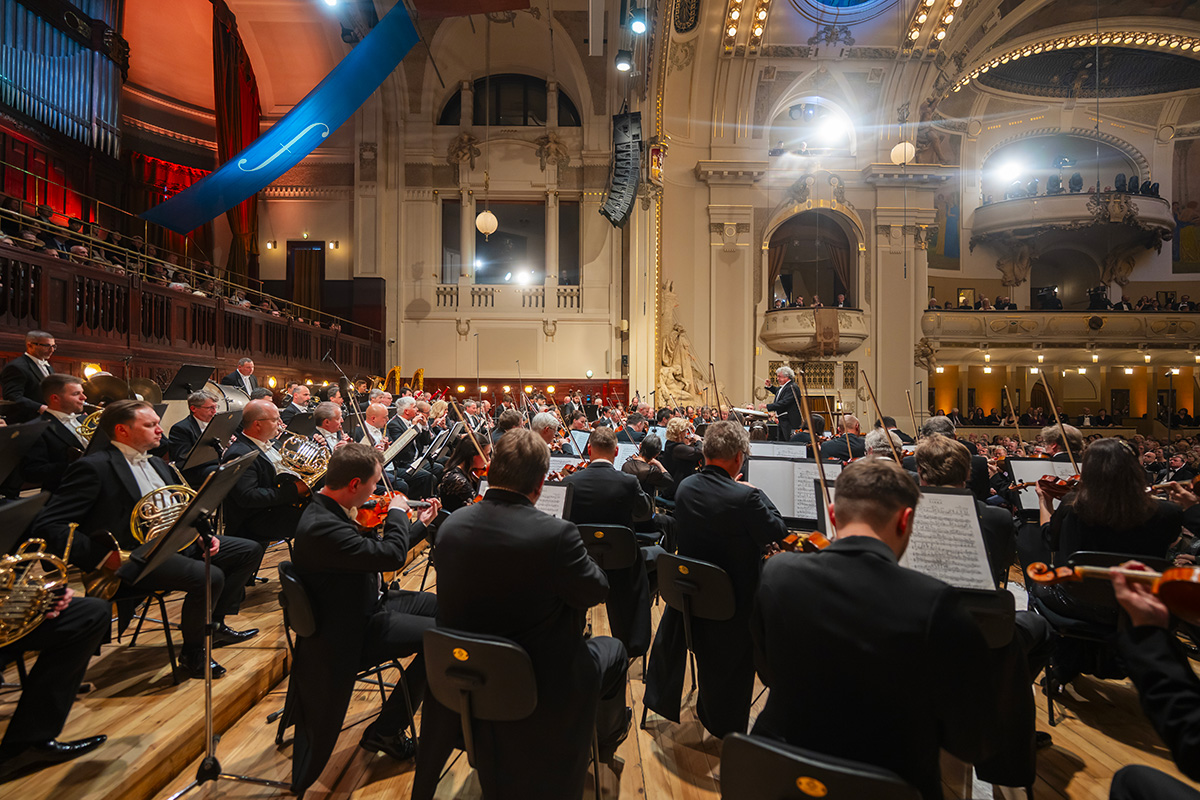
Jakub Hrůša, the new Music Director of the Royal Opera House in London’s Covent Garden, Chief Conductor of the Bamberg Symphony and, from the 2028–2029 season, also Chief Conductor and Music Director of the Czech Philharmonic, will join forces with the Czech Philharmonic at the Prague Spring to present rousing music by Béla Bartók, Leoš Janáček and a classic of the Czech music scene from the latter half of the 20th century, Luboš Fišer. Returning to the festival alongside him is Artist-in-Residence of the Prague Spring 2025, violinist Patricia Kopatchinskaja who, in addition to Rhapsody for Violin and Orchestra No. 2 by one of her favourites, Béla Bartók, will give the Prague Spring premiere of Fišer’s Concerto for Violin and Orchestra. “Patricia and I have already teamed up to perform works by Bartók, Beethoven, Stravinsky and Francesconi, but we’ll be discovering Luboš Fišer together for the first time,” admits Jakub Hrůša. These two superb artists have met up in the recent past to collaborate with the New York Philharmonic, the Bamberg Symphony and the Chamber Orchestra of Europe.
“Undeniably, Bartók and Janáček are two of my favourite composers,” Hrůša tells us. “Both were fundamentally aware of the strength that lies in the authenticity of the folk music of their native countries, yet each treated it in their own special way. The older Janáček with the artistic heart of a romantic, catapulted by his radical thinking into the modernist world of much younger composers, one of whom was Bartók; and then Bartók himself, who appeals to the listeners’ emotions with the same urgency, even though he had a more sober disposition with a more rational approach to constructivist principles. His Miraculous Mandarin, like Janáček’s Fate, has a startling way of drawing the audience out of their comfort zone. These are daring, surprising and very dynamic works,” he adds.

The ballet The Miraculous Mandarin, which Béla Bartók (1881–1945) based on a story by dramatist and later Hollywood screenwriter Melchior Lengyel, ignited a similar scandal in its day to that created in 1913 by Igor Stravinsky’s The Rite of Spring. The world premiere was held in Cologne on 27 November 1926 and, according to conductor Eugen Szenkár’s faithful account, “the uproar was so deafening and lengthy that the fire curtain had to be brought down.” The tale of the prostitute and three accomplices who murder the “miraculous Mandarin” in three different ways, yet he only dies after his sexual gratification, caused a great deal of offence. The outrage was so great in fact, that, at the behest of the then Mayor of Cologne, Konrad Adenauer – the future post-war Chancellor of West Germany, no less –, the production was withdrawn straight after its premiere. Even so, Bartók considered this score to be one of his finest. And the music is truly fantastic: Not only does it boast colourful instrumentation (the orchestra also includes a xylophone, tam-tam, piano, celesta and even an organ), but it also reflects Bartók’s familiarity with Arabic music and music of the Far East. Here, Bartók also uses a number of musical symbols: the Mandarin, for example, is depicted via a mysterious sequence of chords, while the robbers are rendered through a characteristic 6/8 rhythm. The work was presented in Prague a year later, in 1927, where, unlike the incident in Cologne, the Czech production at the Neues deutsches Theater was very well received. The orchestral suite, which will be performed at the Prague Spring, was completed by Bartók in February of that same year.
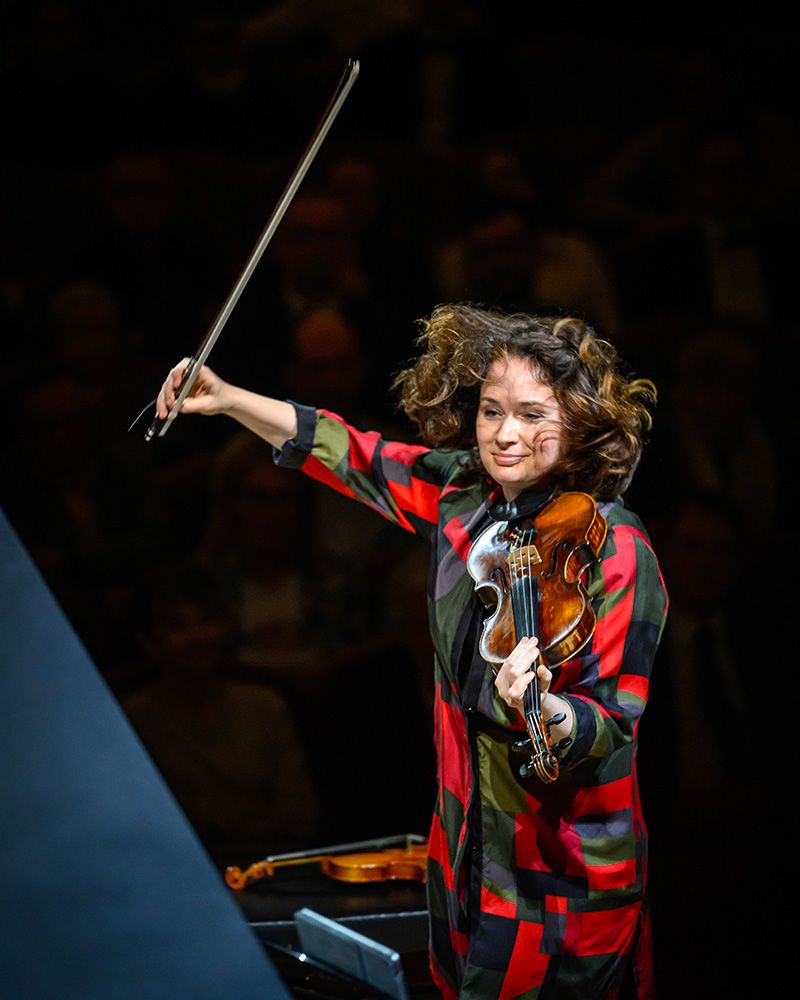
The other Bartók work on the programme will be Rhapsody for Violin and Orchestra No. 2 played by soloist Patricia Kopatchinskaja. She, too, has a great affinity for Bartók. “I think I understand his language. In any case, it’s very close to my soul, but not merely for geographical reasons, since we both come from the same part of the globe, but it’s his true love of rural life, of folk music, it’s his dedication to this culture, which makes sense of my life as well. Folk music is the earth from which I grew up, it’s my soil, my smells, my plants, it’s my story. I feel at home with his music,” says Patricia.
The second, highly anticipated performance by Patricia Kopatchinskaja at this concert will be Concerto for Violin and Orchestra by Luboš Fišer (1935–1999), the composer’s final work for violin, written in 1997. At the Prague Spring in 2025 Patricia presented his Crux for violin, timpani and bells, and the violin sonatas “In memoriam Terezín” and “Hands”, all of which captured the imagination of public and critics alike. “It was the kind of magical evening that I hadn’t experienced all that often at the Prague Spring this century. The celebration of the Czech composer Luboš Fišer was such that it literally took my breath away,” wrote Luboš Stehlík on the website Polyharmonie.cz. Kopatchinskaja, a native of Moldova known for her imaginative, perhaps almost fanciful performances, who has had numerous residencies at such institutions as London’s Southbank Centre and Barbican Centre, Vienna’s Konzerthaus, and the Elbphilharmonie, approaches the music of this timid, modest and somewhat enigmatic genius of 20th century Czech music with her typical passion. “I think we really should make Luboš Fišer famous throughout the world, because his music is so incredibly personal and strong and it has something very, very special,” she says. “I certainly shouldn’t get any credit for the fact that Patricia discovered him and fell in love with his music,” Jakub Hrůša adds with a trace of humility. “On the contrary, I was surprised and touched when she came to tell me how much she admired Fišer’s concerto and that she really wanted to perform it with me. Luboš Fišer is one of my favourite 20th century composers, but I haven’t yet had the honour of conducting his works. So I’m really looking forward to it!”
“I don’t want people sipping beer while they’re listening to Shostakovich. I want people to feel real pain, I want them to succumb to their imagination. I want to delve deeper into their souls,” Patricia speaks openly about what she would like to convey to her audience from the podium. Her joint appearance with the Czech Philharmonic and Jakub Hrůša at the Prague Spring 2026 will certainly appeal to anyone who’s looking to experience something quite out of the ordinary.