
Lucas & Arthur Jussen II
The madness of the big city or a musical ride in a sports car handled by the finest piano duo on the scene today in an ecstatic duel with an arsenal of percussion instruments
Programme
- Béla Bartók: Sonata for Two Pianos and Percussion Sz. 110
- Alexej Gerassimez: Beyond Stickability (for percussion duo)
- George Gershwin: Rhapsody in Blue (arr. for two pianos by Henry Levine)
- Leonard Bernstein: Symphonic Dances from West Side Story (arr. for two pianos and percussion by Peter Sadlo)
- John Adams: Short Ride in a Fast Machine for two pianos and percussion (arr. Alexej Gerassimez)
Performers
- Lucas & Arthur Jussen – piano
- Alexej Gerassimez – percussion
- Emil Kuyumcuyan – percussion
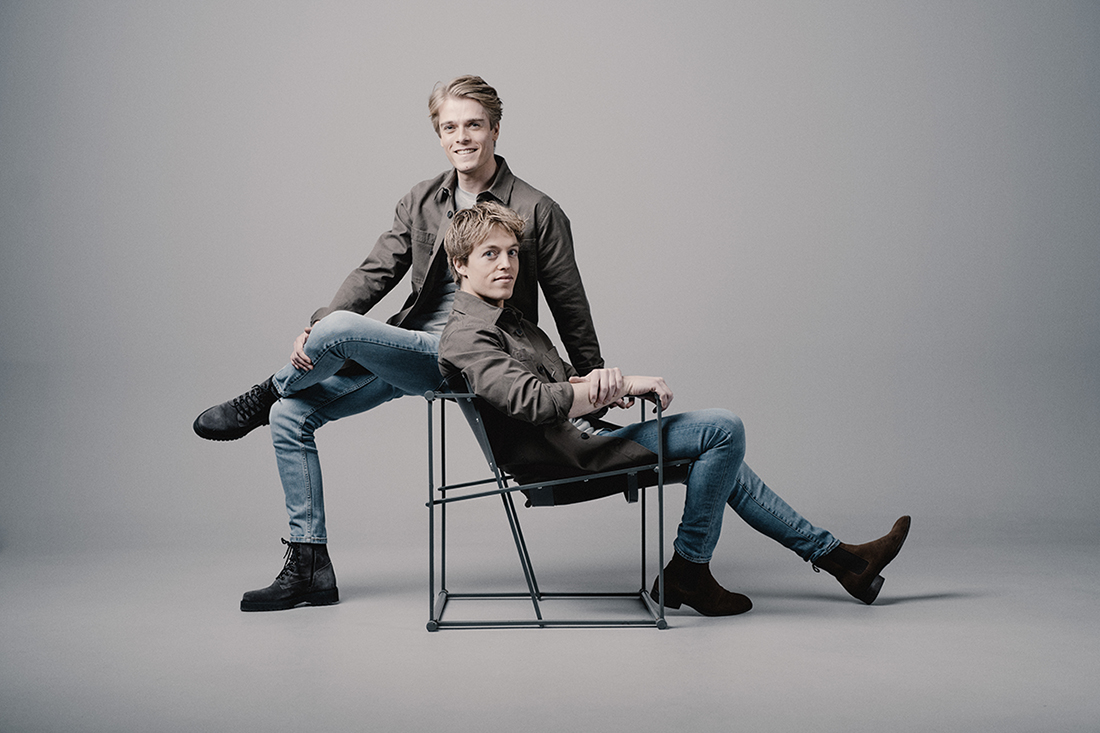
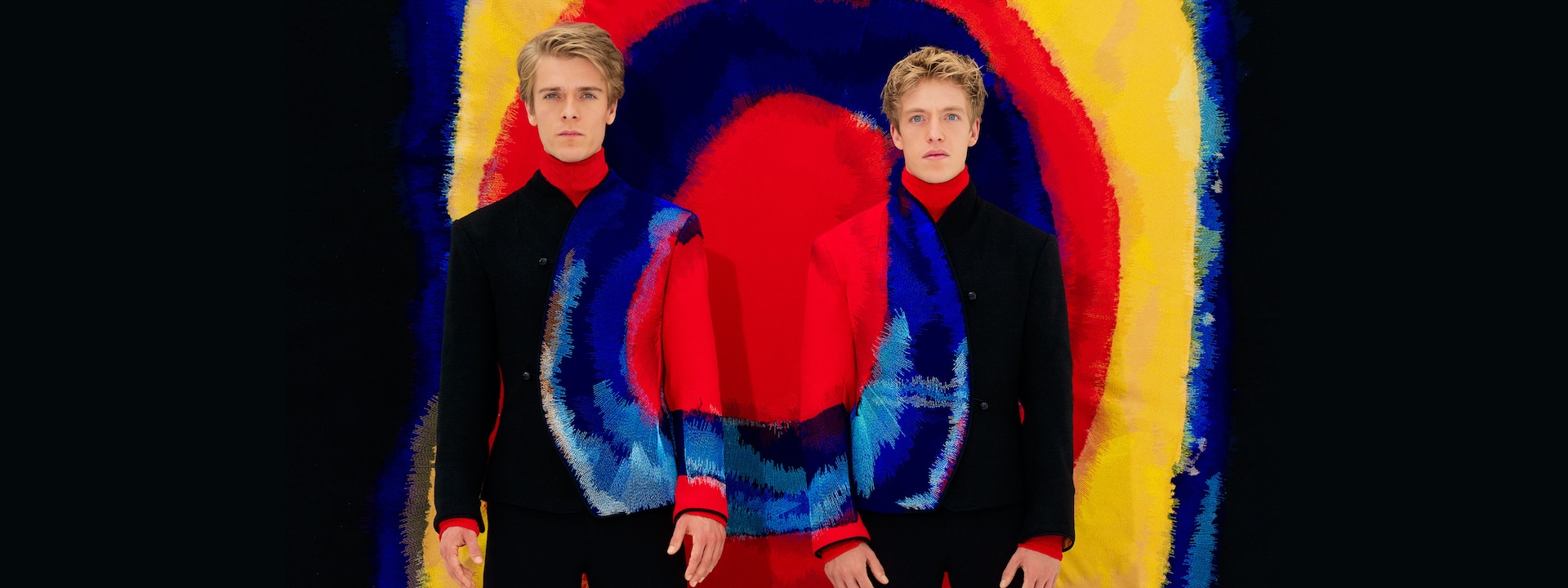
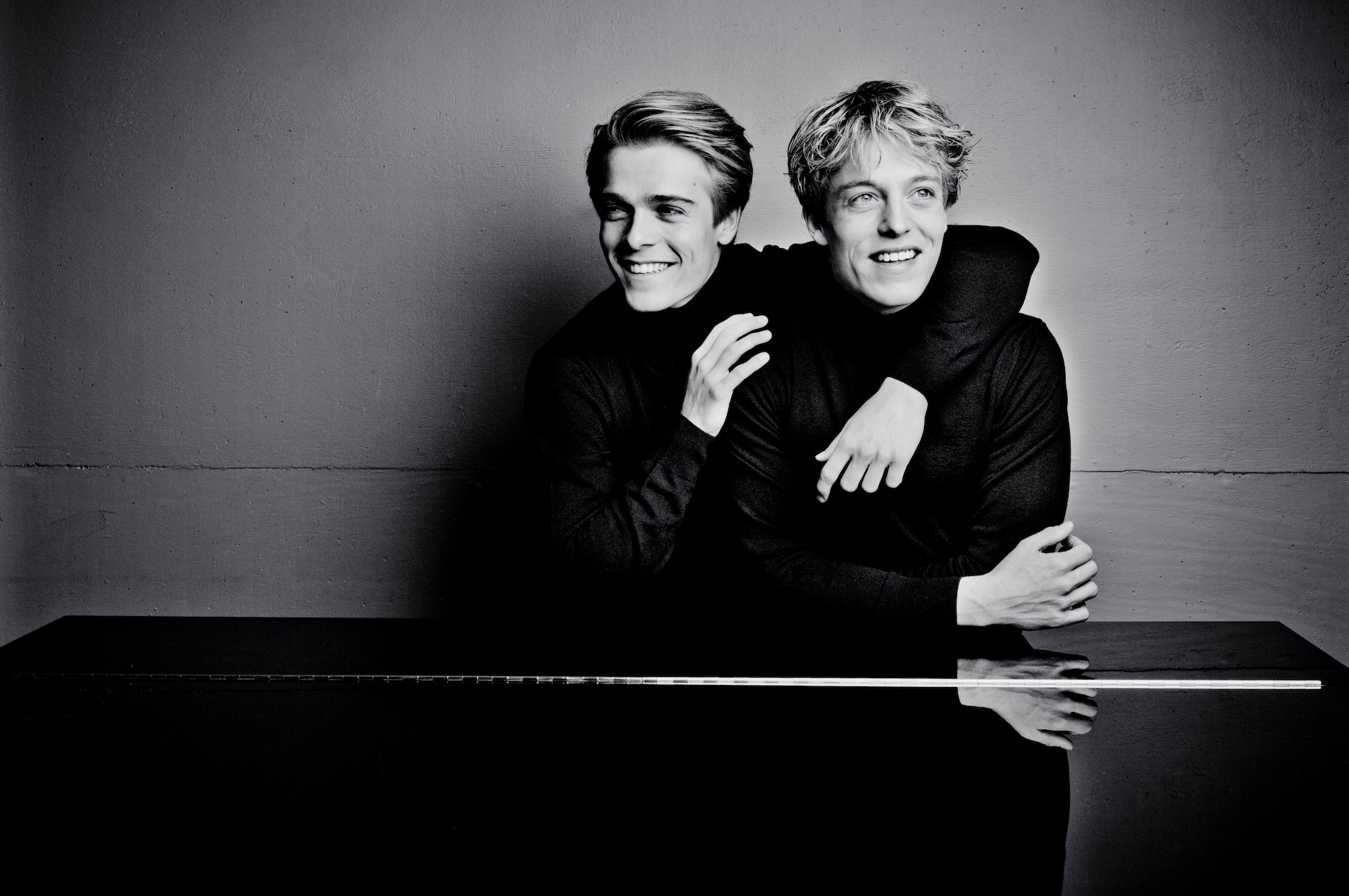
The audience is in for a wonderful musical and visual treat with the second festival concert from stellar piano duo, brothers Lucas and Arthur Jussen. After their first appearance with the Academy of St Martin in the Fields, the Dvořák Hall podium will on this occasion provide the setting for two concert grands and a whole arsenal of percussion instruments handled by two of the world’s finest percussionists: a native of the German city of Essen Alexej Gerassimez and Istanbul-born Emil Kuyumcuyan. The programme offers a thrilling combination of American and European music: Gershwin’s Rhapsody in Blue, the dance suite from Bernstein’s musical West Side Story, featuring the popular Mambo and a cha-cha version of the famous song Maria, and the ecstatic Sonata for Two Pianos and Percussion by Béla Bartók. The cherry on the cake will be a brilliant fanfare by John Adams, Short Ride in a Fast Machine, inspired by a drive in a luxury Italian sports car, along with an original piece by Alexej Gerassimez, whose music is a novel mix of minimalism, jazz and electronics. A programme which showcases the absolute synergy and temperament of the Jussen brothers and presents the piano in entirely new contexts.
“As I had not seen the complicated score before, the task was not easy,” remarked celebrated conductor and pianist Georg Solti, remembering Sonata for Two Pianos and Percussion by Hungarian composer Béla Bartók (1881–1945) and the time when, as a student at the Franz Liszt Academy of Music, he was called upon at the last minute to turn pages for Ditta Pásztory when she was performing the work. In the piece Bartók took the percussive qualities of the piano to the very limit and combined the percussion instruments in such a way that they serve as some kind of coloured canvas. He even specified different kinds of sticks and where they should strike the instruments. Solti was so taken with the work that he recorded it with pianist Murray Perahia and percussionists David Corkhill and Evelyn Glennie in 1988.
We have another treat in store with Rhapsody in Blue by George Gershwin (1898–1937). It seems almost incredible that, in February 2024, one hundred years had passed since this piece was first performed. However, its genesis was somewhat convoluted: the young composer found out from an article in the New York Tribune during a game of billiards that, in a little under six weeks from that moment, a new composition he was apparently writing would be included in a concert held in honour of Lincoln’s birthday. This was the first he’d heard about any such commission. Once his initial panic had subsided, he had a flash of inspiration, and this during a train journey from Boston to New York: “It was on the train, with its steely rhythms, its rattle-ty bang, that is so often so stimulating to a composer… I frequently hear music in the very heart of the noise. And there I suddenly heard – and even saw on paper – the complete construction of the Rhapsody, from beginning to end. […] I heard it as a sort of musical kaleidoscope of America, of our vast melting pot, of our unduplicated national pep, of our metropolitan madness,” Gershwin stated. The instrumentation was completed by Ferde Grofé only a few days before the premiere and the hurried preparations ultimately led to Gershwin improvising some of the solo passages at the concert. He always nodded to the anxious musicians at the end of his solos so they had at least some idea when to come in. Even immortal pieces occasionally start out like this!
The musical West Side Story by Leonard Bernstein (1918–1990) ran for 772 performances during the first two years of its existence. The Symphonic Dances contain nine of its parts, which conjure up the gripping, suggestive, rhythmically vibrant gang scenes, including the famous Mambo. You’ll also hear shouts and fingers clicking, and the lyrical episodes incorporate the memorable songs Somewhere and Maria.
The concert will culminate in the short fanfare Short Ride in a Fast Machine by American composer John Adams (*1948), “a thrilling 4-minute sprint of colour and rhythm”. Adams had this to say about the piece, which was commissioned by conductor Michael Tilson Thomas and originated in 1986: “Since I had recently taken a ride in a very fancy Italian sports car driven by a friend of mine, I had not yet recovered from that rather terrifying experience […] Short Ride in a Fast Machine is an evocation of that experience which was both thrilling and also kind of a white-knuckle anxious experience.”

Born in the German city of Essen, Alexej Gerassimez is rightfully acknowledged as one of the world’s finest percussionists. He is known for his energy, focused performance and sizeable dose of inimitable charisma. His repertoire ranges from the classics and music by contemporary composers to jazz and his own compositions. His skills have inspired a number of composers to write works for him: in the Berliner Philharmonie he gave the world premiere of the concerto for percussion Leviathan by New Zealand composer John Psathas, which he subsequently performed in the Elbphilharmonie, the Düsseldorf Tonhalle and in New Zealand. His world premiere of Double Concerto for Viola, Percussion and Orchestra “Moonlight Concerto” by Finnish composer Kalevi Aho was released by BIS Records in October 2025.
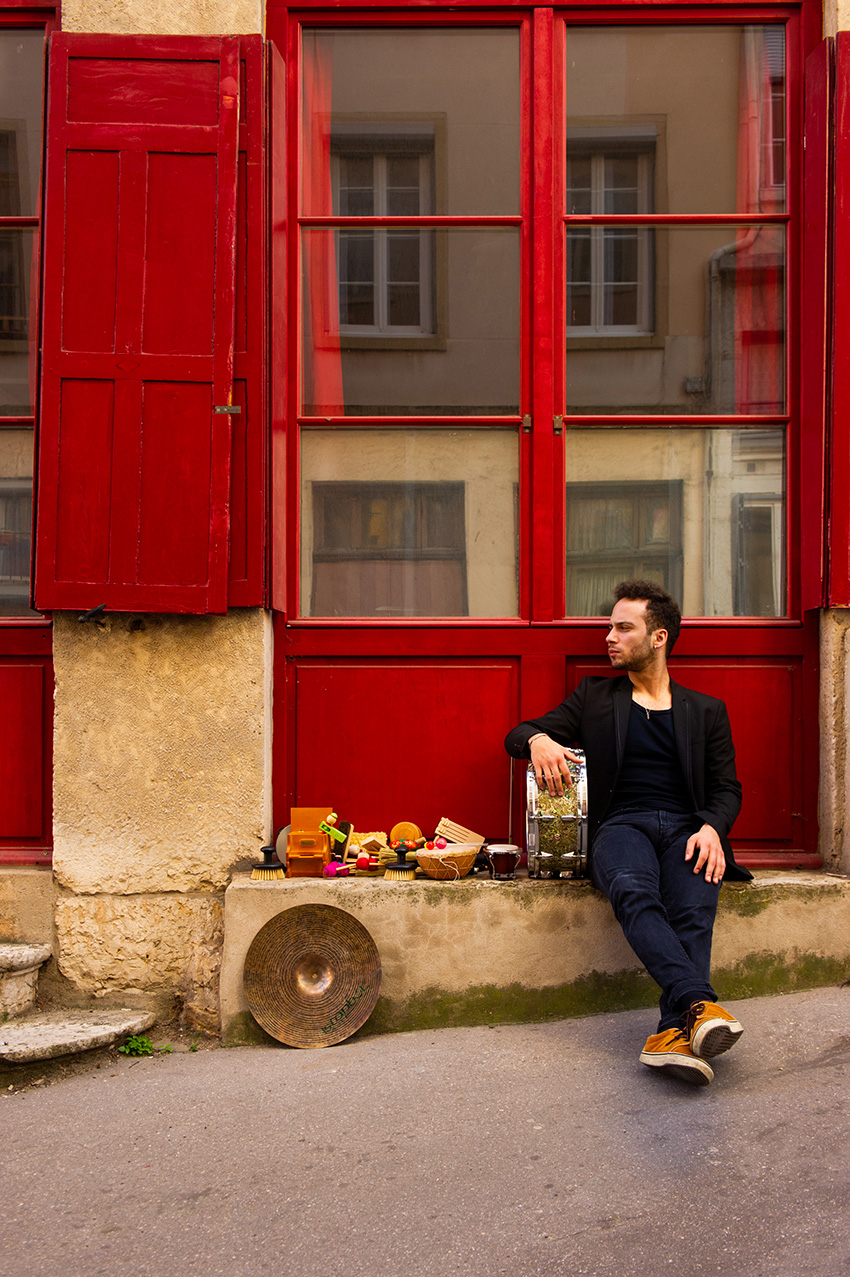
Percussionist, composer and author of electronic music Emil Kuyumcuyan was born in Istanbul into a family with Croatian, Greek, Armenian and African roots. He studied percussion in Turkey, Stuttgart and Lyon. He was a prize-winner at the International Percussion Competition in Luxembourg and he won the Tromp International Percussion Competition, the most important international competition for percussion instruments, and also the Stockholm International Music Competition. He performs all over the world and is a member of the celebrated group Les Percussions de Strasbourg. He has likewise appeared as a guest with a variety of leading contemporary music ensembles, such as Ensemble intercontemporain and Ensemble Modern. His own compositions have been premiered by the Cologne Philharmonic and at Festspiele Mecklenburg-Vorpommern and the Schleswig-Holstein Music Festival.