


Prague Spring Debut
The festival’s twelfth conducting debut will be caught up in a whirl of dance. Copland, Barber, Dvořák and Ginastera performed by Ondřej Soukup, soprano Simona Šaturová and Prague Philharmonia.
Programme
- Aaron Copland: Four Dance Episodes from Rodeo
- Samuel Barber: Knoxville: Summer of 1915
- Antonín Dvořák: Suite in A major Op. 98b
- Alberto Ginastera: Four Dances from Estancia Op. 8a
Performers
- Prague Philharmonia
- Ondřej Soukup – conductor
- Simona Šaturová – soprano
The Prague Spring Debut, a platform for talented young Czech conductors, has become an integral part of the festival, where the eyes of both the public and the critics are trained on the debut performance of a young artist. The twelfth debutant in the series, appearing at the festival in 2026, will be a graduate of the prestigious Royal College of Music in London and laureate of the Ionel Perlea International Conducting Competition, Ondřej Soukup. The artist, who is fast making a name for himself particularly in Great Britain and Scandinavia, will be conducting the Prague Philharmonia for the first time. The young conductor spoke to us about the programme, which focuses on the American continent: “We begin with Copland’s sound of the open American prairies, then time stands still for a while in Barber’s Knoxville. After the break certain movements in Dvořák’s Suite bring to mind Barber’s nostalgia, while others are evocative of Copland’s dance entrée. And with Ginastera we dance our way to the grand finale.” Samuel Barber’s persuasive Knoxville: Summer of 1915 was written to a text by James Agee, Pulitzer Prize-winner and friend of Charlie Chaplin. Its solo part will be performed by excellent Slovak soprano Simona Šaturová, who lent her voice to the prima donna Caterina Gabrielli in the film Il Boemo, which won a Czech Lion award, and in her own career she has appeared with the Vienna Philharmonic under Herbert Blomstedt, Staatskapelle Dresden under Manfred Honeck and the Boston Symphony Orchestra under Charles Dutoit.
Ondřej Soukup is a distinctive, young Czech conductor with a rapidly developing international career. “Ondřej has a great conducting technique, efficient rehearsal technique, along with musical and personal maturity,” declared Dutch conductor Jac van Steen, whom the young artist joined as assistant conductor of the Prague Symphony Orchestra and the National Youth Orchestra of Scotland. At the Royal College of Music he had the opportunity to work with Sir Antonio Pappano, the late Sir Roger Norrington and with Sir Thomas Allen, and he also assisted American conductor Ryan Bancroft with the BBC National Orchestra of Wales and Sweden’s Malmö Symphony Orchestra. Despite his young age he has varied experience not only with the symphonic repertoire but also with opera and choral works from different periods, from Wagner’s Das Rheingold to new compositions by young composers. At the start of 2025 he premiered the opera The Play of the Night by leading Swedish composer Britta Byström. The holder of the Roderick Brydon Memorial Award for talented young conductors, Soukup has already conducted orchestras in Denmark, Sweden, Great Britain and naturally also the Czech Republic. He has also established a composition competition and is closely involved in charity projects.

His Prague Spring debut will have a strong American flavour. The programme opens with Four Dance Episodes by Aaron Copland (1900–1990) from the ballet Rodeo which, during its premiere at the Metropolitan Opera on 16 October 1942, received twenty-two curtain calls! Copland wrote extremely colourful, energetic and, at the same time, lyrical music, evoking the atmosphere of classic American Westerns (a honky-tonk piano even appears in the score at one point), to accompany a choreography by Agnes de Mille. The latter developed the story of an American Cowgirl at Burnt Ranch, who finds herself competing with visiting city girls for the attention of the local cowboys. The composition treats a number of American folk songs – If He’d Be a Buckaroo by His Trade, Old Paint or the ballad Sis Joe – and ends with the closing country hop Hoe-Down in the style of the American square dance. The work, which almost didn’t see the light of day since, at their first meeting, Agnes de Mille sent Copland “to the deuce”, was commissioned and premiered by the Ballet Russe de Monte Carlo, a dance company established in 1932 – named after the famous Ballets Russes headed by impresario Sergei Diaghilev – which moved to the United States during the Second World War.
Five years later another classic of American music, Samuel Barber (1910–1981), wrote an expressive piece entitled Knoxville: Summer of 1915. Barber, who at the tender age of seven sent his mother the telling message “I was not meant to be an athlete, but a composer, and I will be, I am sure. Don’t ask me to go and play football,” wrote the piece at the request of soprano Eleanor Steber. He selected an extract from the novel A Death in the Family by James Agee, amongst others, the screenwriter for the film The African Queen featuring Katharine Hepburn and Humphrey Bogart. A young boy lies in the grass at his home in Knoxville in the state of Tennessee, listening to the sounds around him. He hears the “iron moan” of a streetcar and the “bleak spark crackling and cursing above it like a small malignant spirit set to dog its tracks”. He looks up at the sky, reflects on the sorrows of life and asks God to bless his family; and with this prayer he is taken in and put to bed. Agee’s recollections are autobiographical and indirectly allude to the death of his father, who was killed in a car accident in 1916 when Agee was seven years old. The music suggests to us that Barber was himself a highly proficient singer and that he understood the workings of the human voice. This lyrical work with its exquisite, arching vocal line was premiered by Eleanor Steber, accompanied by the Boston Symphony Orchestra under conductor Serge Koussevitzky.
Suite in A major by Antonín Dvořák (1841–1904) is also strongly associated with America. Originally for piano, the Czech composer wrote it in New York not long after the hectic premiere of the symphony “From the New World”. Here Dvořák in his inimitable way developed his inspiration from American folk music and intuitively melded it with typically Czech dances, such as the polka or the “sousedská”, a slow dance in ¾ time. Perhaps for this reason Dvořák’s masterful work, which he filled with gentle lyricism and also earthiness, is known as the “American Suite”.
The Debut finale will comprise four dances from the ballet Estancia by Argentinian composer Alberto Ginastera (1916–1983). Probably the most important composer from Latin America, he was born in Buenos Aires to a Spanish father and an Italian mother. It is interesting to note that, in 1946, a Guggenheim Fellowship enabled him to study at Tanglewood with Aaron Copland, whom he met in 1941 when the latter was visiting Buenos Aires. Copland’s ballet Rodeo from 1942, the first work on the programme, even suggests the influence of Ginastera’s ballet Estancia, which was written a year earlier and is also inspired by American life and culture. Estancia is set in the South American pampas and ends with the temperamental Malambo, a frenetic dance contest between Argentinian cowboys, known as gauchos. Ondřej Soukup and the Prague Philharmonia will thus close the evening with the stirring rhythms of South American music.
“I’m confident that the maestro composers wouldn’t mind at all if their music urged you to get to your feet and start dancing,” says the young conductor, addressing his festival audience. For his Prague Spring debut he has chosen a programme where he can demonstrate his temperament to the maximum – in short, the festival’s twelfth Debut will be caught up in a whirl of dance!
The history of the Prague Spring Debut
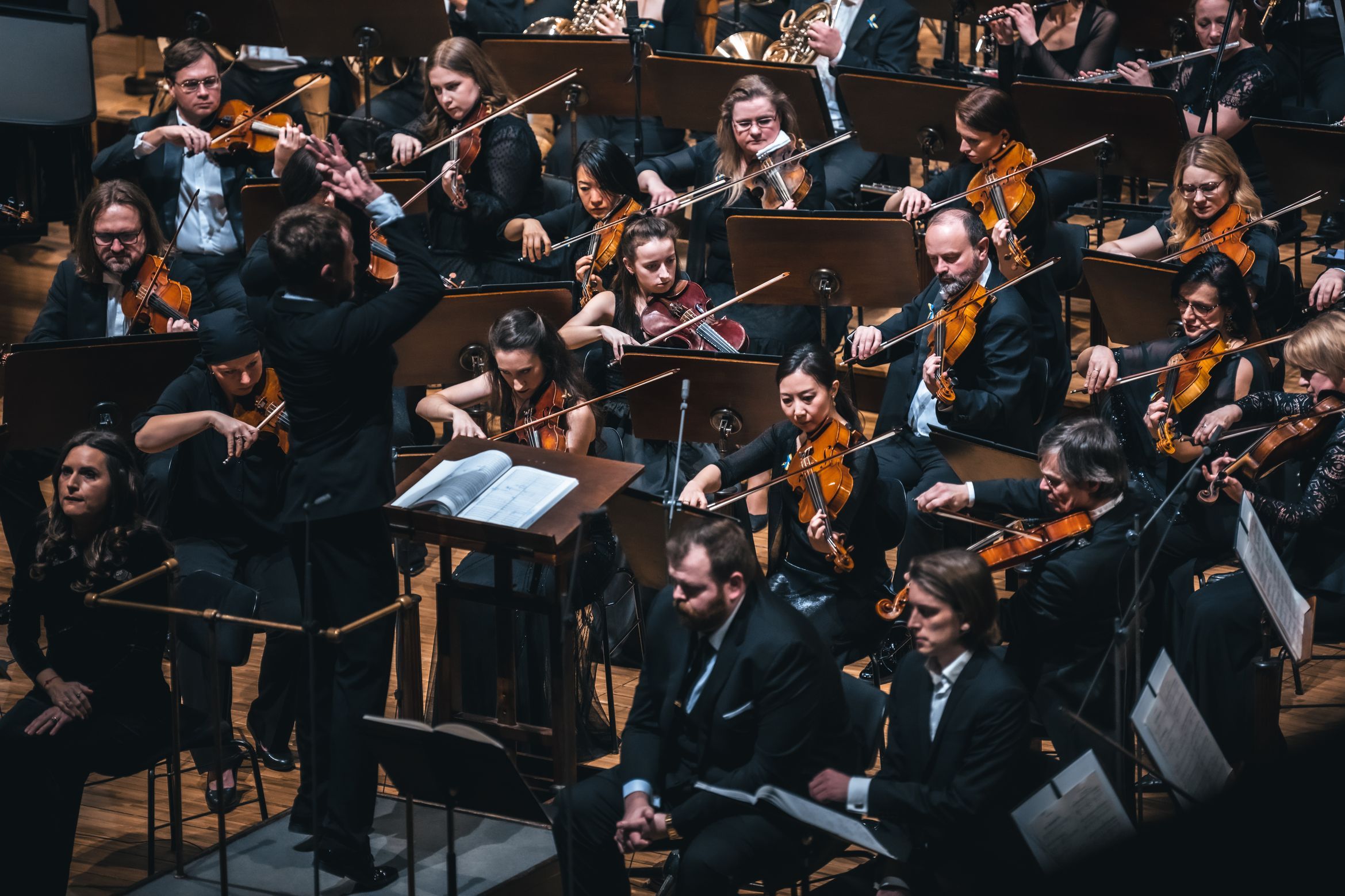
The Prague Spring Debut was established in 2014 by Jiří Bělohlávek, former President of the Prague Spring’s Artistic Board and Chief Conductor of the Czech Philharmonic. It has now become a traditional platform, which enables young male and female conductors to strengthen ties with leading Czech orchestras, to demonstrate their skills before public audiences, and to gain invaluable experience along the way. The Prague Spring Debut has played an important role in the early careers of such artists as Marek Šedivý, Jakub Klecker, Jiří Rožeň, Robert Kružík, František Macek, Marek Prášil and Jiří Habart. The first female conductor to appear in the event was Alena Hron in 2023, while the most recent debutant was Jan Sedláček in 2025. In addition to these Czech conductors, the platform has also hosted two winners of the Besançon International Competition for Young Conductors in France – Jonathon Heyward and Ben Glassberg.