
Semper John Dowland
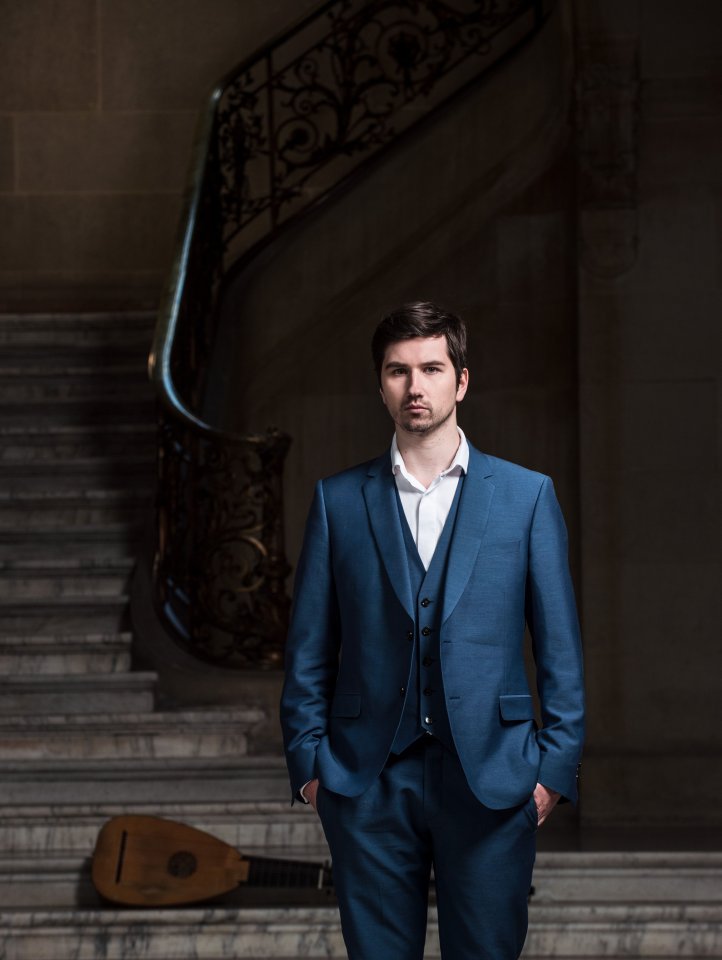
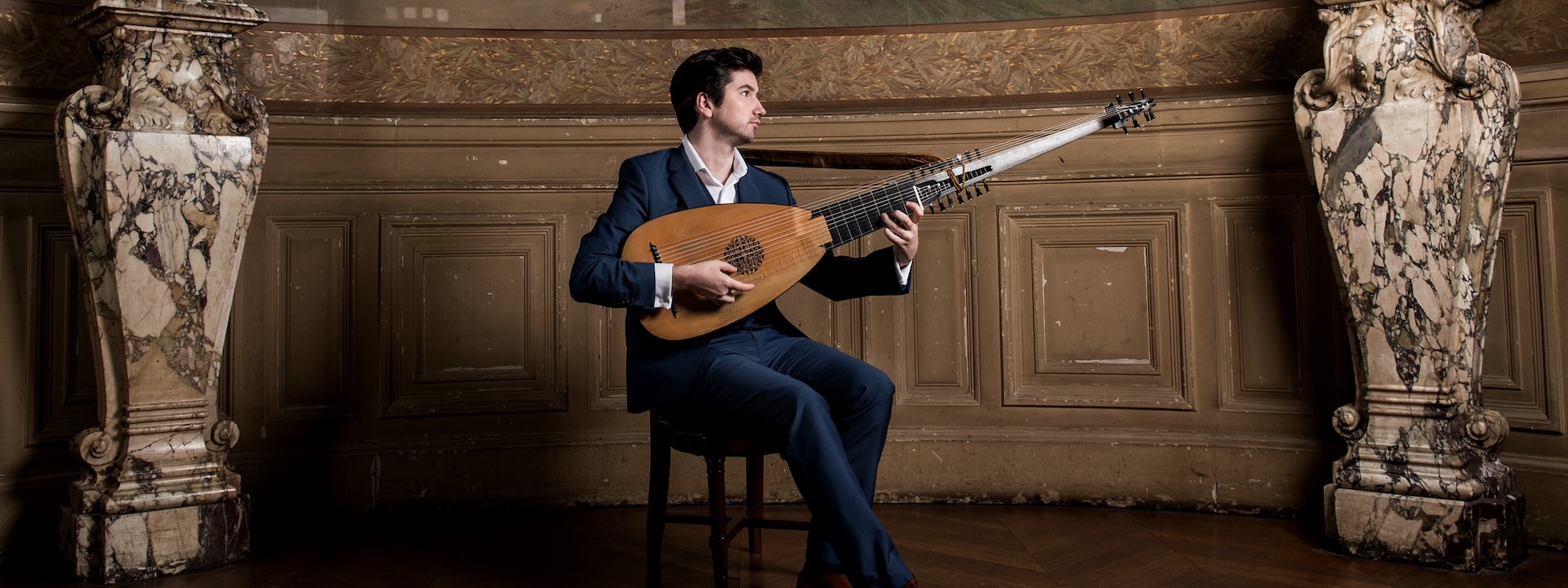
One of the most sought-after French lutenists on the scene today Thomas Dunford will perform pieces by English, French, German and Italian masters of the Renaissance and the Baroque.
Programme
- John Dowland: Praeludium
- John Dowland: Fortune my foe
- John Dowland: A Fancy
- John Dowland: Semper Dowland semper dolens
- John Dowland: Mrs. Winter’s Jump
- John Dowland: A Dream
- John Dowland: The King of Denmark’s Galliard
- John Dowland: Lachrimae
- John Dowland: Frog Galliard
- Girolamo Kapsberger: Toccata No. 6 from the cycle First Book of Lute Tablature
- Juan Ambrosio Dalza: Calata alla Spagnola from the cycle Lute Tablature, Book 4
- Robert de Visée: Sarabande
- Robert de Visée: Chaconne
- Marin Marais: Les voix humaines (arr. Thomas Dunford)
- Johann Sebastian Bach: Chaconne from Partita No. 2 in D minor BWV 1004 (arr. Thomas Dunford)
Performers
- Thomas Dunford – lute
“This programme invites the listener on a journey across Europe through some of the most beautiful and expressive music ever written for the lute. From the profound melancholy of John Dowland, to the bold and inventive writing of Girolamo Kapsberger, the refined elegance of Robert de Visée and Marin Marais, and culminating in the transcendence of Johann Sebastian Bach, this recital reveals the extraordinary range of colours and emotions that the lute can offer. Each piece is a window into the soul of its time, showcasing the instrument’s poetic voice and its timeless power to move us. I’m very much looking forward to sharing this music with the audience in Prague,” says French lutenist Thomas Dunford, describing his debut recital at the Prague Spring. This affable artist, who has given debuts in London’s Wigmore Hall, New York’s Carnegie Hall, the Berliner Philharmonie and the Philharmonie de Paris, will guide us through European Renaissance and Baroque music from a time when the sound of a fragile instrument evoking both melancholy and joy delighted kings and simple townspeople alike. In Prague you’ll be able to savour it in the ideal acoustic environment of St Agnes’ Convent.
Paris native Thomas Dunford is one of the most sought-after lute players on the scene today. He discovered this uncommon instrument at the age of nine, he continued his studies at the Paris Conservatoire and then attended the Schola Cantorum Basiliensis in Switzerland, where he was taught by celebrated lutenist Hopkinson Smith. He also attended masterclasses with such names as Rolf Lislevand, Julian Bream and Paul O’Dette. In 2003 he gave his first performances playing the role of the lutenist in Shakespeare’s Twelfth Night on stage at the Comédie-Française. Since that time he has appeared in some of the world’s most prestigious venues and he collaborates with the finest period instrument ensembles, among them the Academy of Ancient Music and Pygmalion. In 2018 he established his own Jupiter Ensemble where, with considerable open-mindedness, he presents a repertoire spanning an arc from Vivaldi to songs by The Beatles. His regular chamber partners include the harpsichordist Jean Rondeau, one of the discoveries of the Prague Spring 2023. Thomas Dunford’s critically acclaimed recordings are released under the Alpha Classics and Erato labels and he also collaborated on the album Bill and Friends for harmonia mundi where, together with other “friends”, he played alongside legendary conductor and harpsichordist William Christie. He performed at the Prague Spring in 2014 as a member of the famous French ensemble Les Arts Florissants.
At the concert in May 2026, his Prague Spring debut as a soloist, Thomas Dunford will present a cross-section of the most exquisite lute repertoire from the Renaissance and Baroque periods. The evening will begin with a selection of works by one of the most renowned lutenists of the Elizabethan and early Stuart eras, John Dowland (1563–1626). We will hear the famous pavane Lachrimae with its well-known “weeping” motif; The King of Denmark’s Galliard, whose dotted rhythms and repeated notes imitate the sound of military drums and marching soldiers; and the enigmatic Frog Galliard, which became the model for the song Now, o now, I needs must part, about the ugly Duke of Alençon, one of Queen Elizabeth I’s suitors. The programme also offers music by composers associated with sunny Italy: the temperamental Calata alla Spagnola by Joan Ambrosio Dalza (?–1508) and the richly ornamented Toccata by Giovanni Girolamo Kapsberger (1580–1651). We travel to France to hear music by Robert de Visée (1652–1725), lutenist at the court of Louis XIV and Louis XV, and Marin Marais (1656–1728), who was not only a productive composer, but also the father of nineteen children. From the latter’s oeuvre we will hear the piece Les voix humaines, a wonderful work of understated sincerity and depth, a “chant de mémoire”, as aptly described by leading viola da gamba player Paul Rousseau. The programme will end with Dunford’s own transcription of the violin Chaccone from Partita in D minor BWV 1004 by Johann Sebastian Bach (1685–1750), of which Johannes Brahms wrote: “On one stave, for a small instrument, the man [Bach] writes a whole world of the deepest thoughts and most powerful feelings. If I imagined that I could have created, even conceived the piece, I am quite certain that the excess of excitement and earth-shattering experience would have driven me out of my mind.” As a matter of interest, you can hear the same piece in an arrangement by Ferruccio Busoni during Jan Schulmeister’s recital at the Convent of St Agnes on 23 May. With Thomas Dunford, however, you won’t experience the kind of sweeping gestures from Busoni that were typical for the close of the 19th century, but instead tender caresses from the eras of the Renaissance and the Baroque.